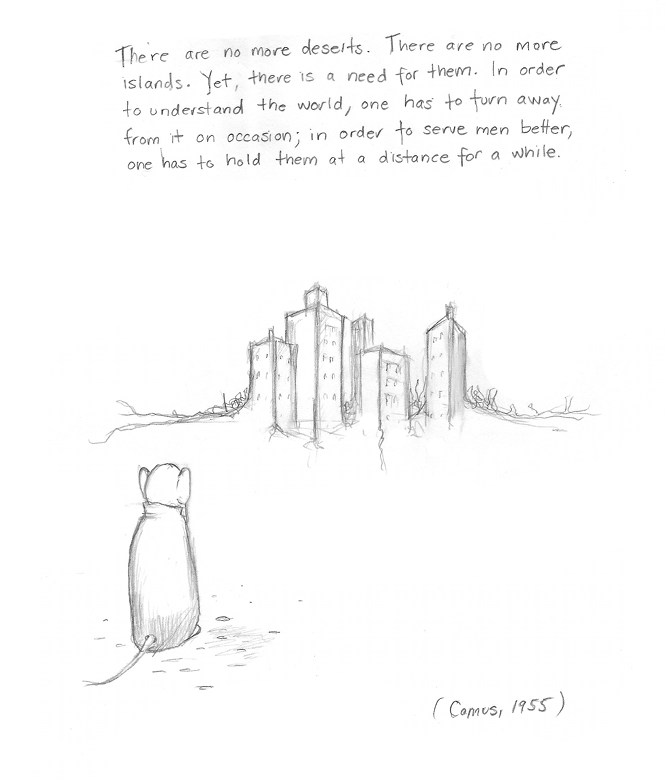
Camus – Hold them at a distance
Image
5


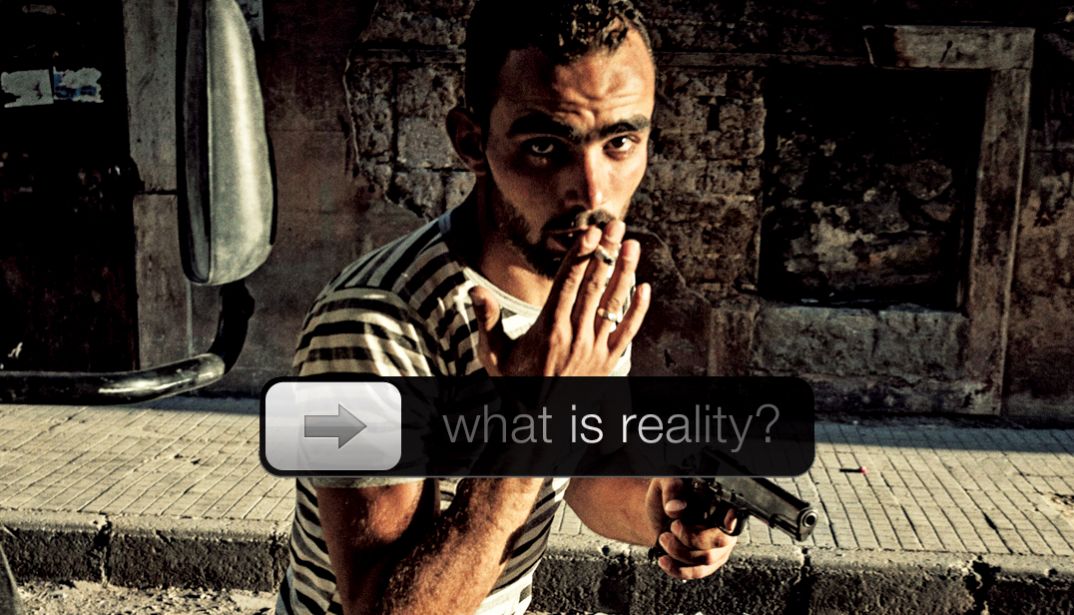
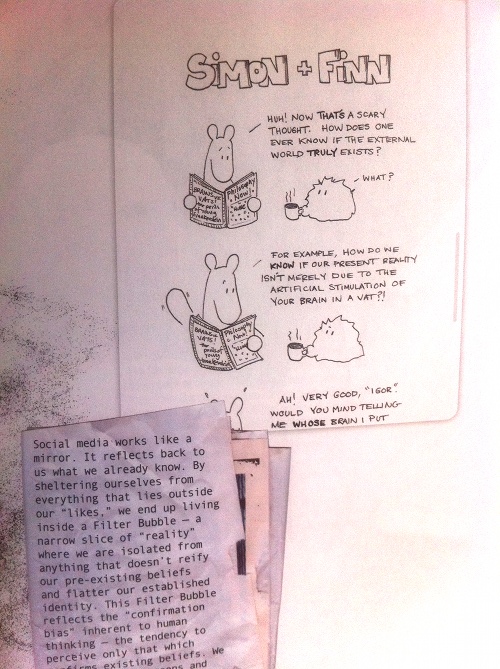
Happy to announce the above Simon & Finn post was repurposed by Adbusters for their fall issue on What Is Reality (hard copy only). . 🙂
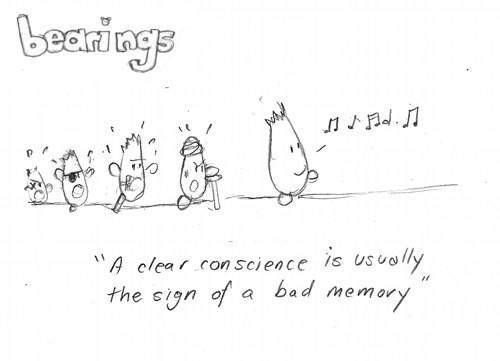
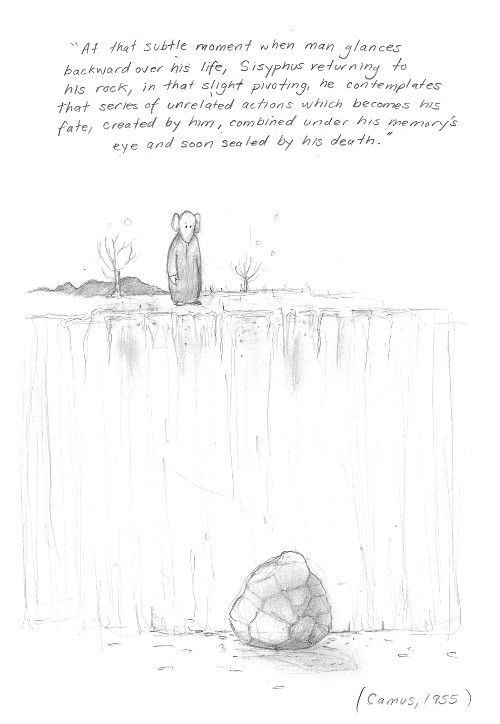
 The following cartoon accompanied the print version of The Impossibility of Maximizing Good Consequences by Lawrence Crocker (Philosophy Now). In the article, the writer posits that various decisions can have vastly different long term consequences.
This is the backbone for chaos theory, or the butterfly effect (i.e. a butterfly flapping its wings in one part of the world can theoretically cause a hurricane in another).
Although the actions that can result in the very best consequences (i.e. maximizing consequences) ought to be favoured, the probability of actually “getting this right” is pretty darn small.

Over the last few months I’ve had the great pleasure of working with children via an artist in residence pilot program at Ryerson University. Curiously I think I learned more from them than they did from me…
The first experimental tranche involved working on large painting while encouraging them to do their own. That idea didn’t last too long once they decided they wanted to help me instead. 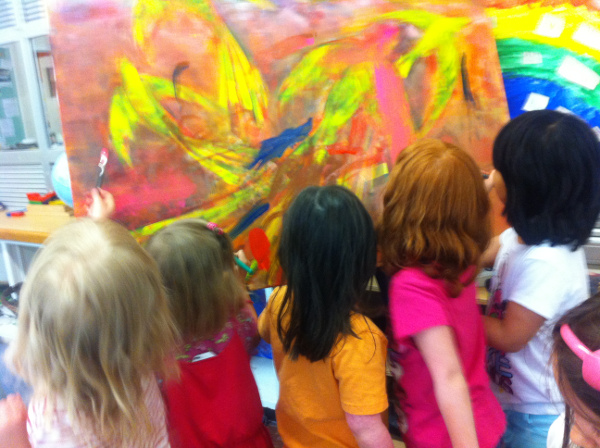 The interesting thing is that the large painting wasn’t quite coming together until they started helping and working with tools and ideas I hadn’t even considered. Check out these tiny little hands doing incredible stuff! Some of them were even jumping to reach the top of the canvas – we decided then that this was dynamic painting in its most literal iteration. 🙂

This was the final happy result, representing about 12 small hands, 24 wide eyes, and 12 open imaginations.

I’ll post a few things on the sculpture experiments another time, but wanted to end this post with the following lovely poem by Margaret Atwood.
You Begin
You begin this way:
this is your hand,
this is your eye,
this is a fish, blue and flat
on the paper, almost
the shape of an eye
This is your mouth, this is an O
or a moon, whichever
you like. This is yellow.
Outside the window
is the rain, green
because it is summer, and beyond that
the trees and then the world,
which is round and has only
the colors of these nine crayons.
This is the world, which is fuller
and more difficult to learn than I have said.
You are right to smudge it that way
with the red and then
the orange: the world burns.
Once you have learned these words
you will learn that there are more
words than you can ever learn.
The word hand floats above your hand
like a small cloud over a lake.
The word hand anchors
your hand to this table
your hand is a warm stone
I hold between two words.
This is your hand, these are my hands, this is the world,
which is round but not flat and has more colors
than we can see.
It begins, it has an end,
this is what you will
come back to, this is your hand.
— Margaret Atwood

I really struggled with this strip on every level.. drawing, writing, formatting.. one of those days I guess! And now I just spotted a spelling mistake too. Gr.
The opening quote is courtesy of Camus, in The Myth of Sisyphus.
******************************************************************************

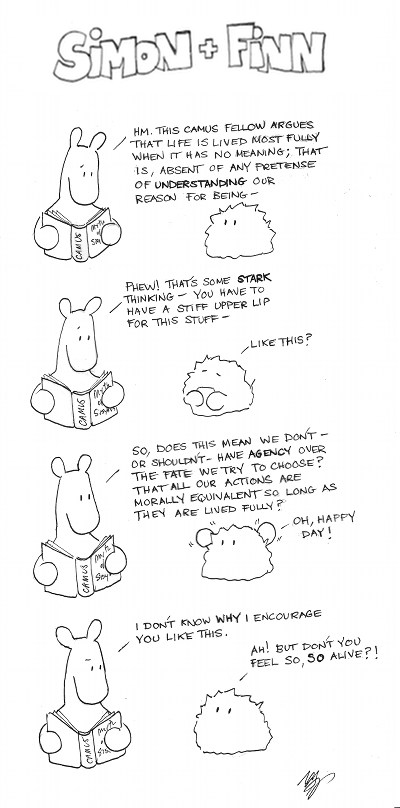 “Is one going to die, escape by the leap, rebuild a mansion of ideas and forms to one’s own scale? Is one, on the contrary, going to take up the heart-rending and marvelous wager of the absurd?”
So writes Camus in Absurd Freedom, a small section in the book The Myth of Sisyphus (thank you J. Swift!). As near as I can tell, in this section Camus argues against the constructs we use to try to define, understand, render meaning to, and ultimately constrain life – our “bureaucracy of mind and heart” which, regardless of our desperate efforts, do not write us a blank cheque on eternity…
Instead, he argues that dying unreconciled and not of one’s own free will is essential – – as, “life will be lived all the better if it has no meaning”.
Yes, you heard that right! To continue to live with impunity and abandon in the great unknowable shadow of absurdity is the ultimate revolt against oblivion!
(Or, as per The Slow Room…)
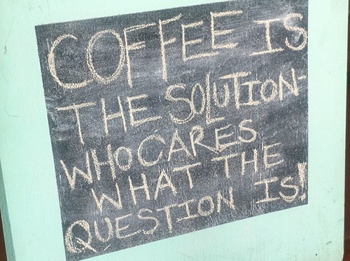 P.S. On a tangential note, this got me to thinking about how we tell stories.. with beginning, middle, and end, and especially through endorsing satisfactory resolution of all introduced threads. It’s no wonder we struggle with accepting the non-reconciliation of our own lives, given we are taught that good stories should always have closure as well as karmic balance.
 simonandfinn