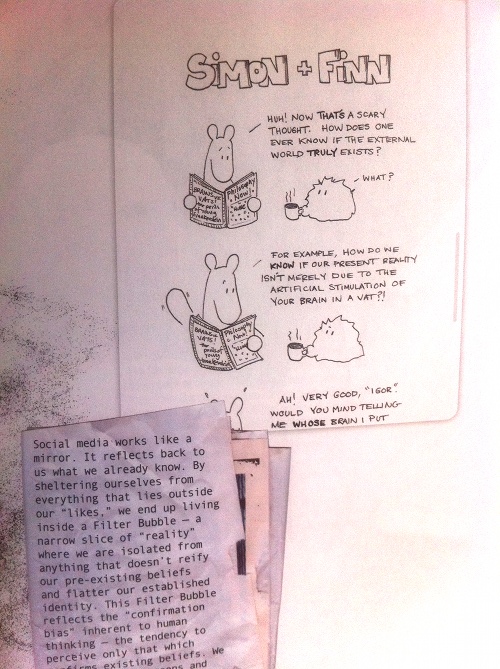
Happy to announce the above Simon & Finn post was repurposed by Adbusters for their fall issue on What Is Reality (hard copy only). . 🙂

Happy to announce the above Simon & Finn post was repurposed by Adbusters for their fall issue on What Is Reality (hard copy only). . 🙂
 The following cartoon accompanied the print version of The Impossibility of Maximizing Good Consequences by Lawrence Crocker (Philosophy Now). In the article, the writer posits that various decisions can have vastly different long term consequences.
This is the backbone for chaos theory, or the butterfly effect (i.e. a butterfly flapping its wings in one part of the world can theoretically cause a hurricane in another).
Although the actions that can result in the very best consequences (i.e. maximizing consequences) ought to be favoured, the probability of actually “getting this right” is pretty darn small.
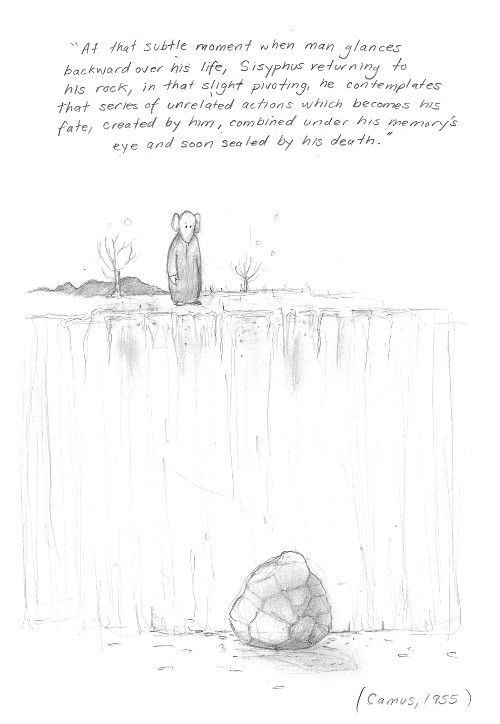

I really struggled with this strip on every level.. drawing, writing, formatting.. one of those days I guess! And now I just spotted a spelling mistake too. Gr.
The opening quote is courtesy of Camus, in The Myth of Sisyphus.
******************************************************************************

 “Is one going to die, escape by the leap, rebuild a mansion of ideas and forms to one’s own scale? Is one, on the contrary, going to take up the heart-rending and marvelous wager of the absurd?”
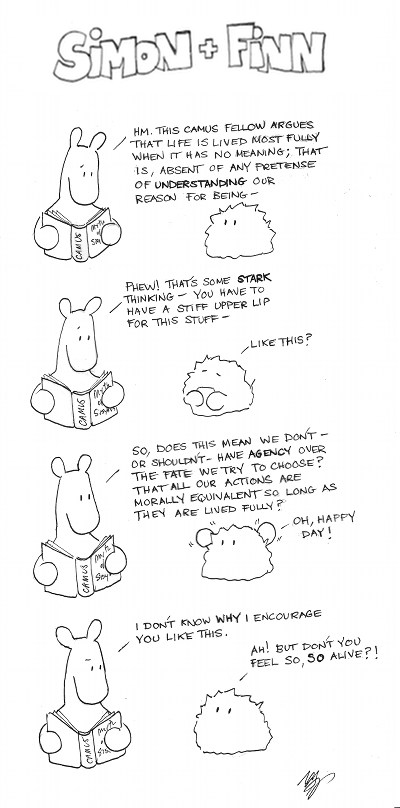
So writes Camus in Absurd Freedom, a small section in the book The Myth of Sisyphus (thank you J. Swift!). As near as I can tell, in this section Camus argues against the constructs we use to try to define, understand, render meaning to, and ultimately constrain life – our “bureaucracy of mind and heart” which, regardless of our desperate efforts, do not write us a blank cheque on eternity…
Instead, he argues that dying unreconciled and not of one’s own free will is essential – – as, “life will be lived all the better if it has no meaning”.
Yes, you heard that right! To continue to live with impunity and abandon in the great unknowable shadow of absurdity is the ultimate revolt against oblivion!
(Or, as per The Slow Room…)
 P.S. On a tangential note, this got me to thinking about how we tell stories.. with beginning, middle, and end, and especially through endorsing satisfactory resolution of all introduced threads. It’s no wonder we struggle with accepting the non-reconciliation of our own lives, given we are taught that good stories should always have closure as well as karmic balance.
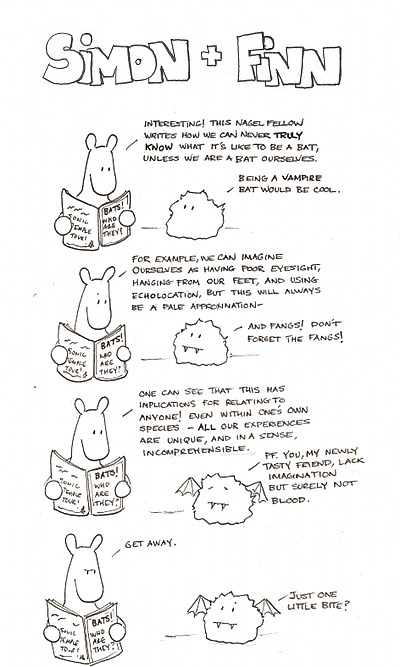 So… this week’s S&F took a convoluted path. I have been (trying to) read Camus’s Myth of Sisyphus and was ranting about how perplexed I was by certain passages.
My friend took that opportune moment to introduce me to Thomas Nagel, more specifically his essay on “What is it like to be a bat”. Now who could turn down a (short!) essay with a title like that, especially when it also contains such rarities as: “Even without the benefit of philosophical reflection, anyone who has spent some time in an enclosed space with an excited bat knows what it is like to encounter a fundamentally alien form of life.” Is that.. a sense of humour one can detect?! I thought that was fundamentally alien to philosophers!
More seriously, it is a rather good essay that discusses how difficult it is to truly “get” something or somebody else without experiencing everything they do in their exact way. I suppose our shared experience of life itself is the one major thing we all have in common, but within that so much else can differ, making relating to each other form a sort of tragic Venn diagram.
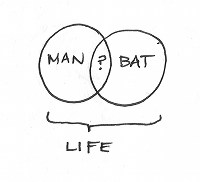 P.S. I was trying to remember if “echolocation” is spelled with an “h”… I thought it was just with a “c”, as in “ecolocation” but then it was pointed out that would only be used by environmental bats. 🙂
 “A drawing is simply a line going for a walk.” – Paul Klee

For my dear friend Maggie, who posts the most exquisite and colourful recipes on her blog, Maggie’s Way.
The following cartoon accompanied the print version of A Justification of Empirical Thinking (Philosophy Now). The article got me to thinking about the Matrix film where Neo is asked whether he wanted to take the blue pill (fabricated reality) vs. the red pill (the truth behind the reality). This fork in the road seems loosely based on a classical philosophical problem, that being Hume’s problem of induction, that is, how do we know whether reality is real? Can we trust our experience of our senses? Or, is this all an illusion as we row, row, row our boats, gently down the stream?
 “You take the blue pill, the story ends. You wake up in your bed and believe whatever you want to believe. You take the red pill, you stay in wonderland, and I show you how deep the rabbit hole goes.“
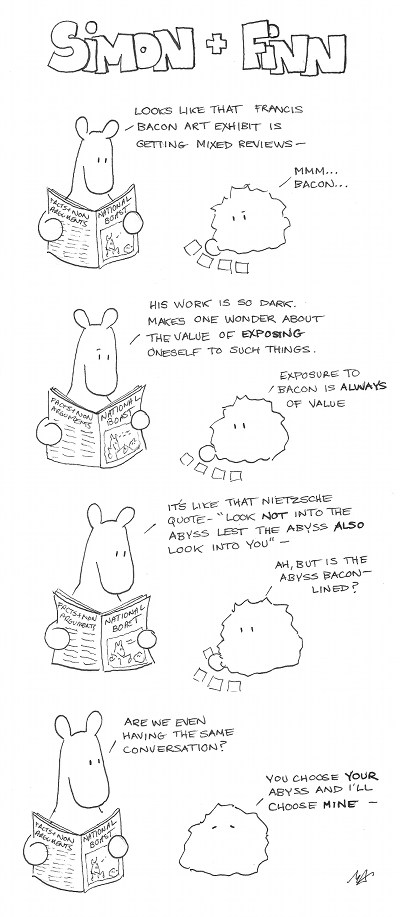 This cartoon came out of a visit to the Francis Bacon and Thomas Moore exhibit at the Art Gallery of Ontario. I’m not a fan of Bacon’s work due to how grotesquely he interprets humanity, which makes for disturbingly visceral viewing experience.
Anyhow, the visit gave rise to subsequent debates about what one chooses to experience in life, in that the lover of knowledge cannot remain merely an observer. So… is it always best to seek out all knowledge, regardless of what that knowledge is? Or, is it sometimes best to deliberately look away from the awful when one has the choice?
I don’t have the answer of course, but do think Nietszche’s abyss quote touches on the spiritual echo that can result from our choices. For a lighter take on this concept, feel free to check out a prior illustrated story, Ernie & The Nietzsche Monster.
“I am a painter of the 20th century: during my childhood I lived through the revolutionary Irish movement, Sinn Fein, and the wars, Hiroshima, Hitler, the death camps, and daily violence that I’ve experienced all my life. And after all that they want me to paint bunches of pink flowers … But that’s not my thing. The only things that interest me are people, their folly, their ways, their anguish, this unbelievable, purely accidental intelligence which has shattered the planet, and which maybe, one day, will destroy it.” – Francis Bacon, 2003
 simonandfinn