Beware the Conversation Weasel

I'm way too cute for it not to be all about me.

In 2011, The Art of Manliness published a sweet piece on Conversational Narcissism.  It’s an interesting read, and the tenets will be familiar to many i.e. “Last month I met up with an old friend I hadn’t seen in forever…. Having both read and written about how to be an effective and charismatic conversationalist, I followed the old dictum of listening more than talking and asking the other person engaging questions about themselves. This is supposed to charm your conversation partner. I guess it worked because my friend talked about himself for an hour straight and didn’t ask me a single question.

Sound a little familiar?  What’s neat about the article is that sociologist Charles Derber (whose book The Pursuit of Attention inspires much of the piece) has deconstructed some of the ways people masterfully – and subtly – monopolize the conversation back to ego numero uno.

Take the following two examples:

Example 1:

James:   I’m thinking about buying a new car.
Rob:      Oh yeah?  What models have you looked at?

Example 2:

James:    I’m thinking about buying a new car.
Rob:        Oh yeah?  I’m thinking about buying a new car too.
James:    Really?
Rob:        Yup, I just test drove a Mustang yesterday and it was awesome.

Woah!!  Did you catch that weaselly move in Example 2?  Rob, henceforth “Conversation Weasel”, has sneakily moved the attention away from James and placed it squarely on himself, in a verbal strategy Derber calls “shift-response” (as opposed to the polite and engaging “support-response” demonstrated in Example 1).  The post goes on to elaborate on a number of fascinating ways Conversation Weasel can leave the listener high and dry while running away madly with the conversation football.

The author offers a nice little insight into the why of this, by stating: “In a time where a lot of the old social supports people relied upon have disappeared, people have become starved for attention. They bring this hunger to their conversations, which they see as competitions in which the winner is able to keep the attention on themselves as much as possible. And this is turning the skill of conversation-making into a lost art.”

P.S. This whole discussion seems rather evocative of the conch shell symbolism in William Golding’s Lord of the Flies. In this book, a group of shipwrecked boys decide that “he who holds the conch” has the authority to speak without interruption, and that anyone within the group has the right to the conch.  The conch in this case helps to ensure a degree of egalitarianism and collectivism to how group decisions are discussed and made.  However, as the story unfolds, group structure breaks down, the rules of engagement disintegrate, the conch is shattered, and anarchy reigns supreme.

Now.. I’m not saying that Conversation Weasel sets out to create anarchy, but it’s mighty tricky to build something together when we’re all grabbing for the conch.
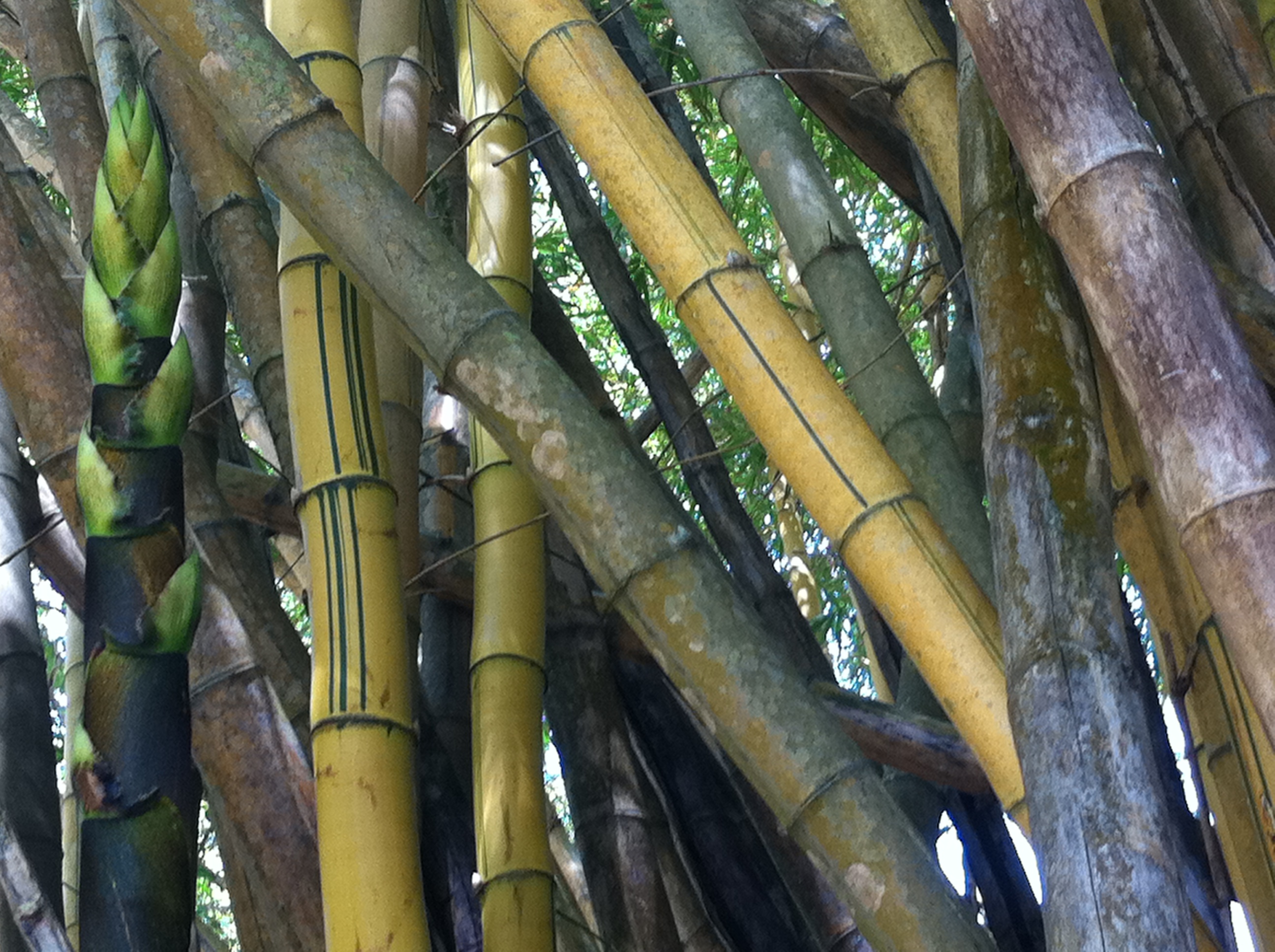
Pandas: Available in black, white, and shades of grey

Low cal diet: A curious taste for bamboo

BlogTO recently posted about the two cute pandas coming to the Toronto zoo on a five-year loan (Wouldn’t it be better if the pandas just stayed home?). The gist of that post was: (1) why spend all that money on pandas when there are so many other native species that could use the funding; (2) some feel the zoo is overly optimistic about how much revenue the pandas will bring in given their ~$1 million/yr price tag (never mind the $200K price tag for imported bamboo!) and (3) to recognize international goodwill between China and other countries via live bear currency seems a little strange (a.k.a. the bizarre emergence of panda diplomacy).

In this complicated world, it seems like the more one looks into something, the less black and white it is – unlike our furry subject, ironically.  Consider a few brief aspects (to do with pandas, less so with international diplomacy):

  • So few:  At one point the panda came very close to extinction and the species is still one of the rarest on the planet. I had no idea that there are only an estimated 1,500 to 3,000 pandas left in the wild, and about 240 to 333 in zoos (estimates vary depending on source).  That’s not a lot of pandas is it?
  • Two day window: Despite the huge difficulty in mating pandas in captivity as well as in the wild (the female is only in estrous for two days a year), zoos have been successful in increasing the population of captive pandas from 150 to 333.
  • Panda “loans” can help:  Loans of giant pandas between China and other countries — panda diplomacy — costs hosting countries up to $1M U.S.D. a year.  In some cases a portion of these loan fees are directed to conservation efforts for the giant panda and its habitat.
  • Who decides?  Some conservationists have controversially expressed that the giant panda is too expensive to save and that funds would be better spent on protecting “less expensive” animals and their habitat.   Giant pandas are considered unlikely to thrive in the wild due to habitat decline and their proclivity for massive amounts of low-calorie bamboo. Arguments for concentrating on our own backyard (i.e. own local species and habitat) are convincing.
  • Someone’s got to lead the charge:  Yet, others argue that the panda is a keystone species – and, as a flagship icon of wildlife conservation – does enormous amounts for the protection of habitat and other less known species that similarly depend on this habitat, as well as the conservation movement in general.

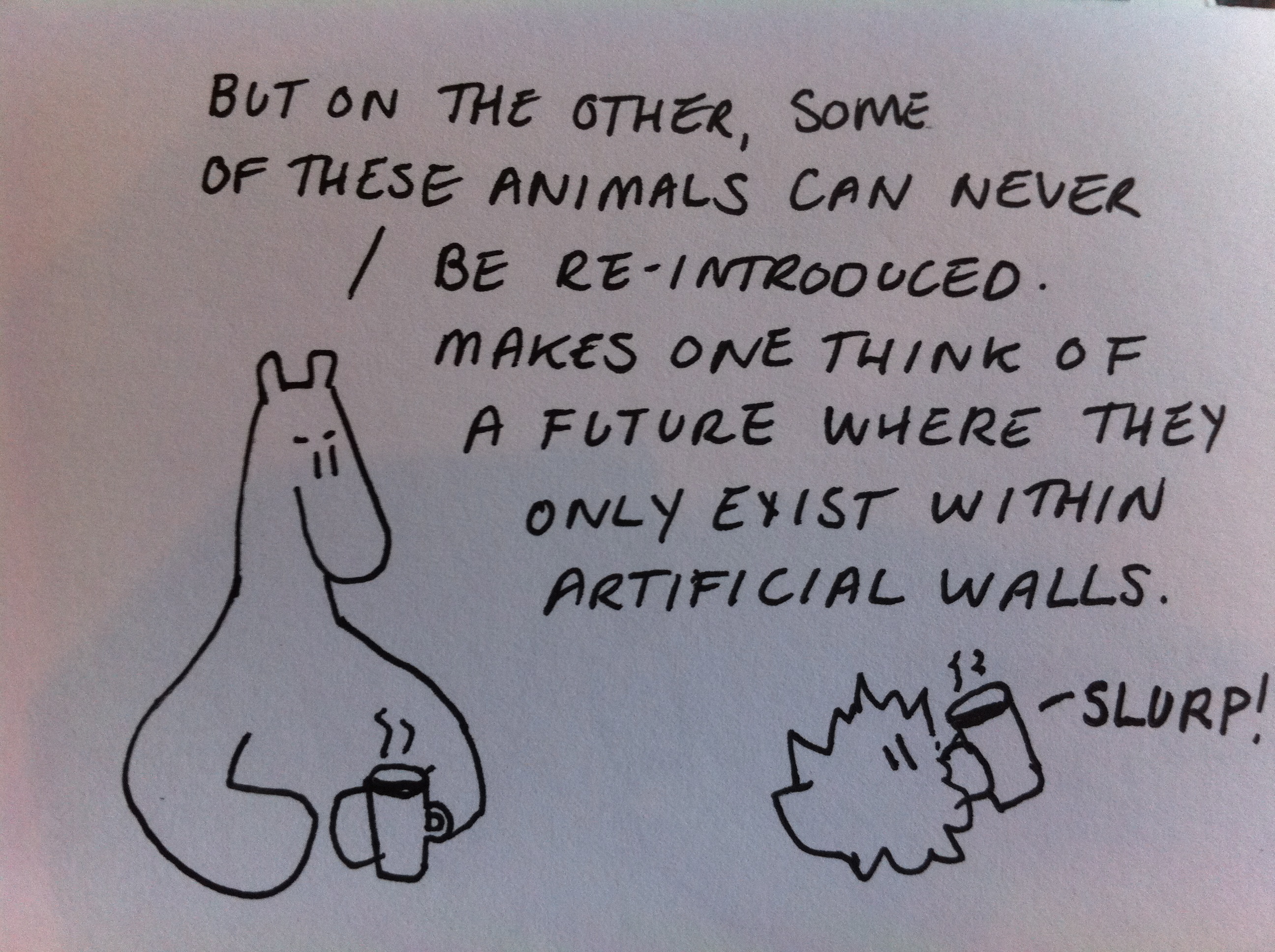
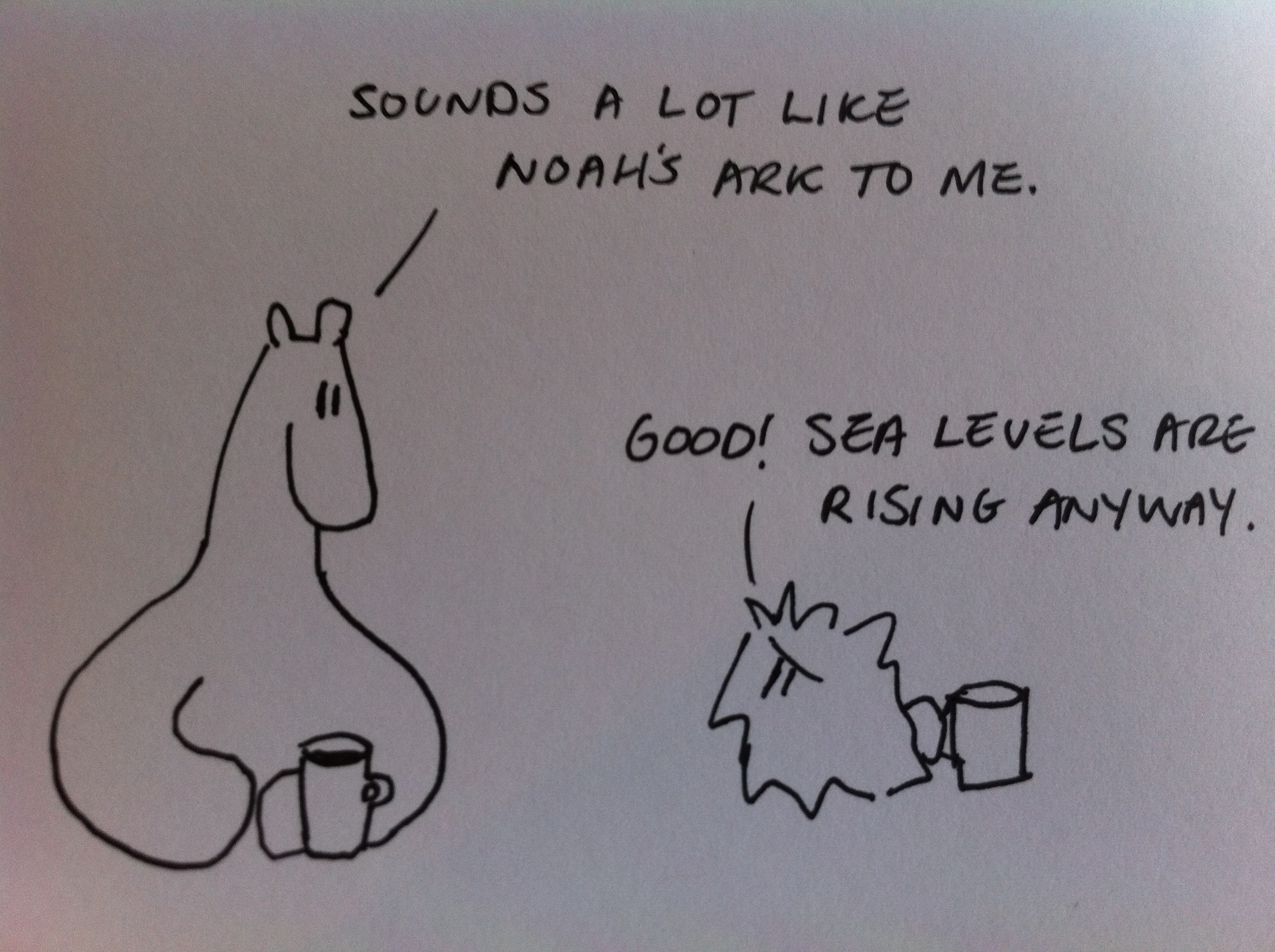
And there’s a lot more where that came from. It’s a complicated world out there, and it’s sure not getting any simpler.  However, there is one aspect in which many agree, and that is that the future chances of these animals flourishing in the wild is slim (for example, in the wild breeding pandas need about 30km2 of land to support them – but most populations are now isolated in narrow 1.2km-wide fragments).  This means that regardless of how well we succeed at captive breeding, without immediate broader scale and significant habitat protection, the only place we’re going to be seeing some of these animals in the future is behind bars – and that goes for a lot more species than just pandas.

At this pace of development, many of our global brethren are purring, whirring, walking, and running full-tilt into an animated parody of Sabre-Tooth Tiger and Woolly Mammoth exhibits…. and no matter what side of the exhibit you’re on there’s something terribly sad about that.