S&F in Philosophy Now: What would George Bataille do?

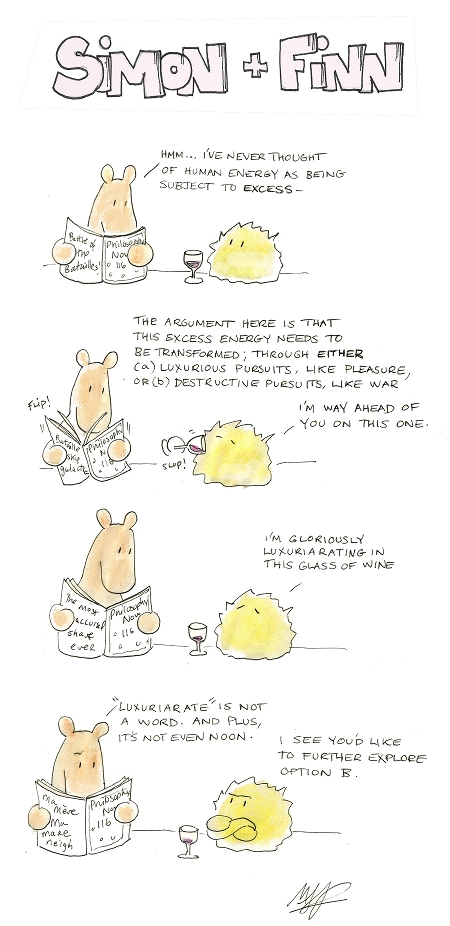
The following accompanied the print version of: What would George Bataille Do? by Alexandra Tzirkoti (Issue #116, Philosophy Now). The article itself is a nice tongue-in-cheek intro to the thinking of a rather controversial figure (link below).sf-bataille-300dpi-webhttps://philosophynow.org/issues/116/What_Would_Georges_Bataille_Do

S&F in Philosophy Now: Facts & Opinions

The following cartoon accompanied the print version of “Facts & Opinions” by Christoffer Lammer-Heindel (Philosophy Now, Issue 115). In this piece, Lammer-Heindel argues that there are important distinctions to be drawn between the two. As usual, Simon & Finn have their own take. 🙂

S&Ffactopinion WEBFor further reading: https://philosophynow.org/issues/115/Facts_and_Opinions

S&F in Philosophy Now: Conspiracy theory

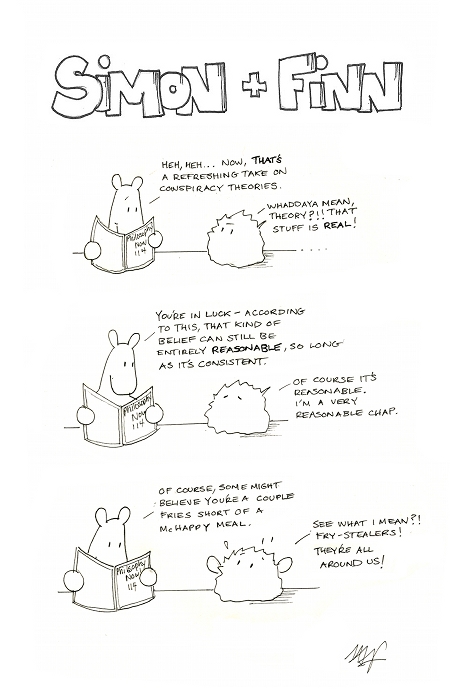
The following cartoon accompanied the print version of Stephen Brewer’s article “The Conspiracy of Theories” (Issue 114, Philosophy Now). The piece “stealthily records a dialogue in which Freya argues that conspiracy theories are illogical, but Orin is not so sure”, proving that even the wildest of conspiracy theories can be reasonable so long as their principle axioms are consistent. Who knew!

Read more at:   https://philosophynow.org/issues/114/The_Conspiracy_of_TheoriesS&F conspiracy 900x1396 300dpi WEB

S&F in Philosophy Now: Boozy musin’s

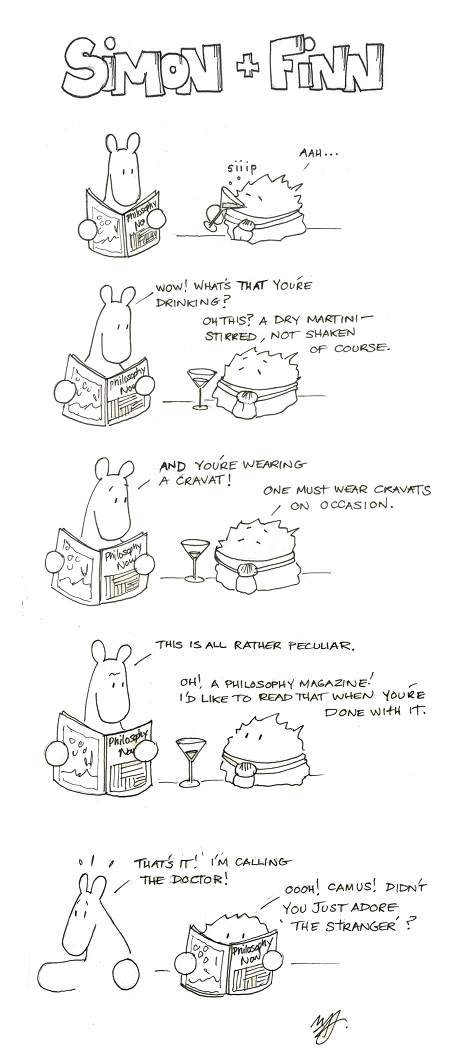
The following cartoon accompanied the print version of Robin Small’s piece on philosophy annnd – wait for it – cocktails! (“Philosophy & Cocktails” Issue 113 of Philosophy Now). In this delightful article the author explores the equally valid contribution cocktails have made to late night philosophical discussion, traditionally considered the primary purview of wine. For some easy reading on the subject, take a look at HuffPost’s New York Cocktail Philosophy: http://www.huffingtonpost.com/skye-cleary/new-york-cocktail-philoso_b_7827076.htmlS&F Martini 300dpi web


S&F in Philosophy Now: Friendship and Altruism

Hello! The following cartoon accompanied the print version of Daniel Tippen’s article: “Why Self-Interest Makes Relationships Valuable” (Issue 112 of Philosophy Now). In this article the author discusses the nature of friendship and its relationship to altruism. As altruism can take many forms, in this case it is argued that it is only genuine altruism that is the basis for true friendship.

S&F Self-Interest - web

S&F in Philosophy Now: The Free Will of Ebenezer Scrooge

The following cartoon accompanied the print version of The Free Will of Ebenezer Scrooge, by Richard Kamber (Philosophy Now, Issue 111).

The article, which delves into arguments relating to determinism and free will, is available here and the cartoon is loosely based on a very bad morning indeed. 🙂

S&F Many Paths - web


S&F: Beware the Minotaur

I’ve been reading an interesting book “Art and Spiritual Transformation” by Finley Eversole. Amongst other thought-provoking chapters, he has one dedicated to the underlying symbolism of the labyrinth. For example, did you know the distinction between mazes and labyrinths? As follows:

Maze: A series of underground tunnels and passages with intersecting paths that wander chaotically, winding back on themselves or terminating in dead ends.

Labyrinth: Seven circuits of one path which lead eventually – and only – to the centre.

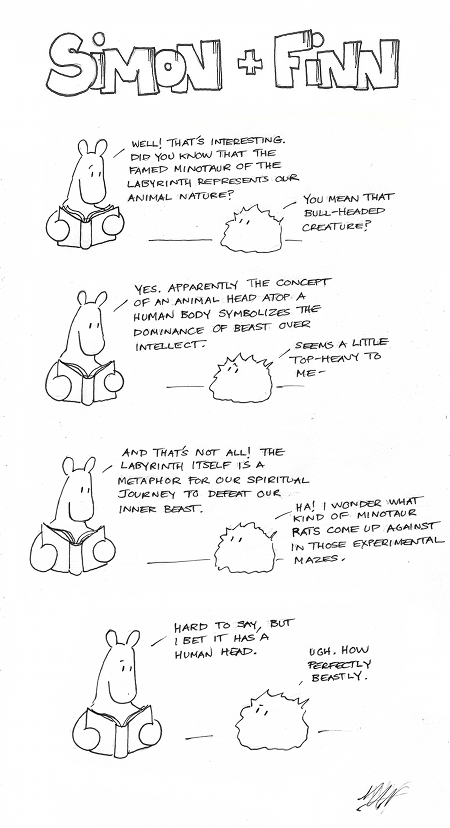
Eversole goes on to discuss how the general ‘lost’ feeling of life is akin to wandering within a maze, however when one begins to focus on spiritual transformation this maze sublimates into a labyrinth. Of course, at the centre of the labyrinth who does one find but the Minotaur. The Minotaur is said to be representative of our animal nature; a creature in which the beast rules the intellect. This is indicated by the bull head atop a human form.

To be able to escape the labyrinth, therefore, it is said that we must defeat the Minotaur and thus symbolically defeat our animal nature. Only when the Minotaur is vanquished can we find our way from out the Labyrinth by following Ariadne’s silver thread. The silver thread is allegorical for our spiritual nature, always apart and yet nearby, should we choose to pursue it…S&F minotaur RGB web

S&F in Philosophy Now: The Paradox of Liberalism

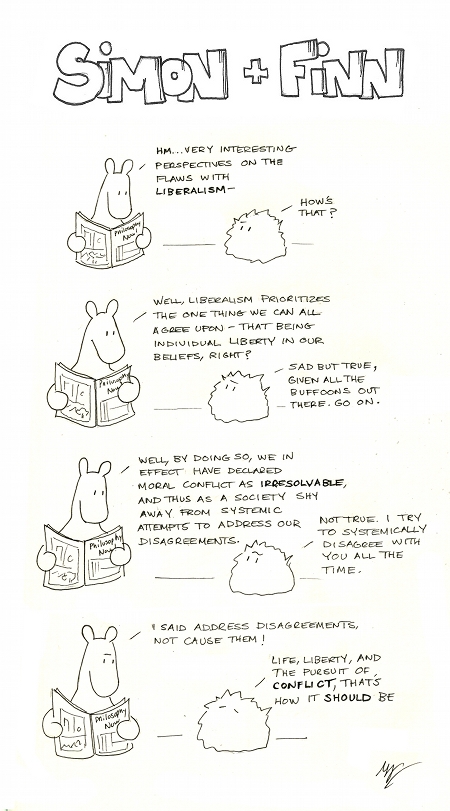
The following cartoon accompanied the print version of Francisco Uribe’s article “The Paradox of Liberalism” (Philosophy Now, Issue 110).  In this article, the writer discusses why the rise of fundamentalism poses particular challenges for liberalism given the latter’s core tenet that individuals should be able to act as they see fit…

S&F Liberalism 900x1621 300dpi sm

Sculpture: Leopard Ray

ray1This is Biscotti the Leopard Ray.. a somewhat fanciful interpretation of an otherwise much more elegant creature. 🙂  Biscotti is made up of chicken wire, Sculpey clay, acrylic paint, and two free ebony buttons from the Beadery on Queen St.

ray3


S&F in Philosophy Now: The Prisoner’s Dilemma

The following cartoon accompanied the print version of Brian Kings’s article “The Prisoner’s Dilemma and The Evolution Of Morality” (Philosophy Now, Issue 109).  In this article, the writer explores the evolution of morality through game theory, specifically: The Prisoner’s Dilemma. This is a game that you “win” by getting the lowest number of years in jail. The outcome depends on whether or not you decide to rat out your partner in crime, thereby exemplifying either selfish or cooperative behaviour. Ideally, both partners would remain silent… ideally.
S&F Prisoner's Dilemma 900x1737 300 dpi - smallFeel free to read more about the game and its tenets here, which is summarized in the following image. https://en.wikipedia.org/wiki/Prisoner%27s_dilemma

prisoners_dilemma - small