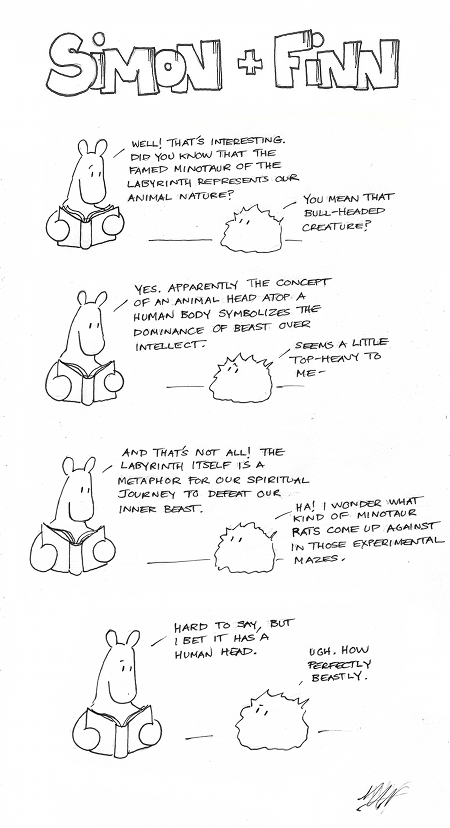
S&F: Beware the Minotaur

I’ve been reading an interesting book “Art and Spiritual Transformation” by Finley Eversole. Amongst other thought-provoking chapters, he has one dedicated to the underlying symbolism of the labyrinth. For example, did you know the distinction between mazes and labyrinths? As follows:

Maze: A series of underground tunnels and passages with intersecting paths that wander chaotically, winding back on themselves or terminating in dead ends.

Labyrinth: Seven circuits of one path which lead eventually – and only – to the centre.

Eversole goes on to discuss how the general ‘lost’ feeling of life is akin to wandering within a maze, however when one begins to focus on spiritual transformation this maze sublimates into a labyrinth. Of course, at the centre of the labyrinth who does one find but the Minotaur. The Minotaur is said to be representative of our animal nature; a creature in which the beast rules the intellect. This is indicated by the bull head atop a human form.

To be able to escape the labyrinth, therefore, it is said that we must defeat the Minotaur and thus symbolically defeat our animal nature. Only when the Minotaur is vanquished can we find our way from out the Labyrinth by following Ariadne’s silver thread. The silver thread is allegorical for our spiritual nature, always apart and yet nearby, should we choose to pursue it…S&F minotaur RGB web
S&F in Philosophy Now: The Paradox of Liberalism

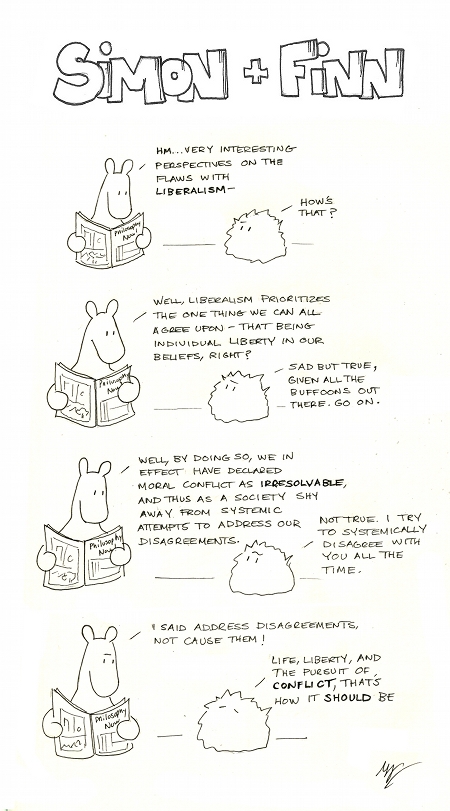
The following cartoon accompanied the print version of Francisco Uribe’s article “The Paradox of Liberalism” (Philosophy Now, Issue 110).  In this article, the writer discusses why the rise of fundamentalism poses particular challenges for liberalism given the latter’s core tenet that individuals should be able to act as they see fit…

S&F Liberalism 900x1621 300dpi sm

S&F in Philosophy Now: The Prisoner’s Dilemma

The following cartoon accompanied the print version of Brian Kings’s article “The Prisoner’s Dilemma and The Evolution Of Morality” (Philosophy Now, Issue 109).  In this article, the writer explores the evolution of morality through game theory, specifically: The Prisoner’s Dilemma. This is a game that you “win” by getting the lowest number of years in jail. The outcome depends on whether or not you decide to rat out your partner in crime, thereby exemplifying either selfish or cooperative behaviour. Ideally, both partners would remain silent… ideally.
S&F Prisoner's Dilemma 900x1737 300 dpi - smallFeel free to read more about the game and its tenets here, which is summarized in the following image. https://en.wikipedia.org/wiki/Prisoner%27s_dilemma

prisoners_dilemma - small

S&F in Philosophy Now: The Moral Worth of Animals

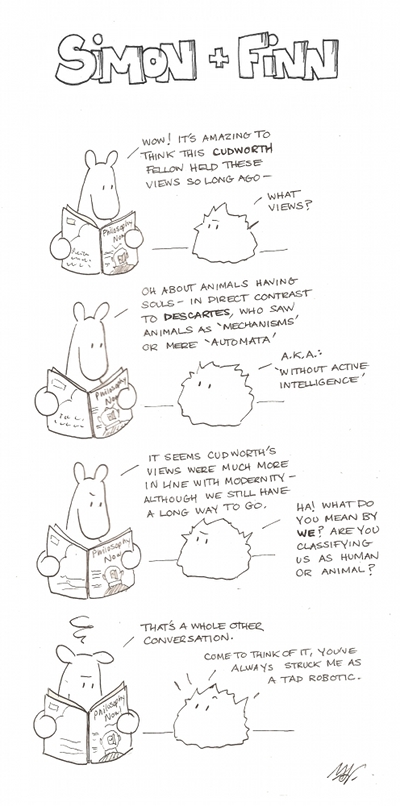
The following cartoon accompanied the print version of Samuel Kaldas’s article Descartes vs. Cudworth on The Moral Worth of Animals (Philosophy Now, Issue 108). In this article, the writer compares two views on the nature of animals and their implications for our moral responsibility towards them. It’s interesting to compare Descartes views – disturbing to many today – to those of his contemporary Cudworth, who held surprisingly modern views for his time. Article link provided below.S&F Descartes 300 dpi 400 x 800 https://philosophynow.org/issues/108/Descartes_versus_Cudworth_On_The_Moral_Worth_of_Animals


S&F: Lachesis

The following is very loosely based on the recent research in telomeres, aging & disease. I took a bit of a left turn into Greek mythology. Everyone needs more Greek mythology in their life.

S&F - Lachesis 400 x 800

S&F Nanoparticles

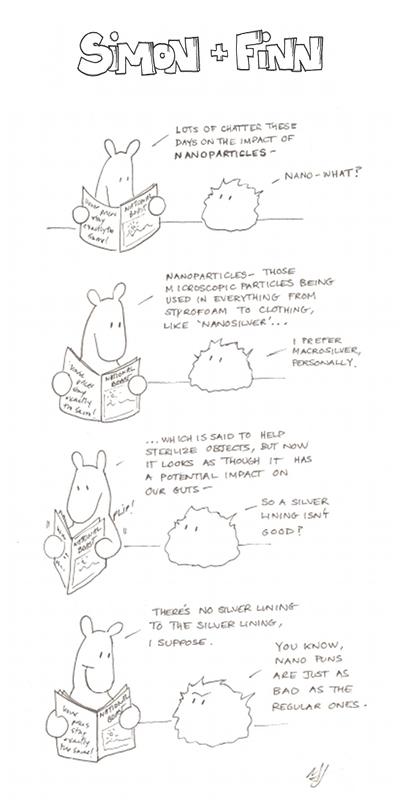
The following S&F cartoon was created for The Potent, a Canadian environmental news and media blog. It’s surprisingly difficult to find consistent information about the impact of nanoparticles on human/environmental health, but I wouldn’t be surprised if we read more about them in the future.

S&F - Nanoparticles blog

S&F in Philosophy Now: Personal Identity

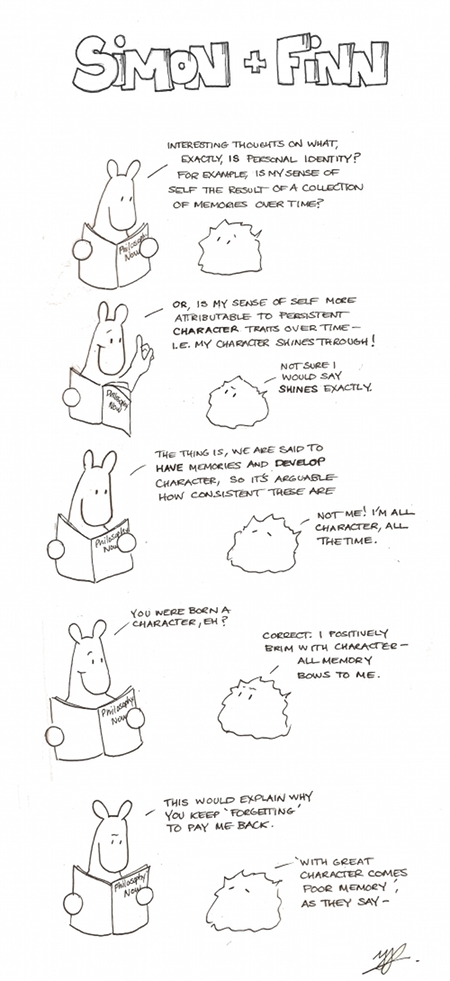
The following cartoon accompanied the print version of Joshua Farris’s What’s So Simple About Personal identity? (Philosophy Now, Issue 107). The article discusses the various theories about what makes up personal identity. For example, some feel that identity is ultimately the result of the collection of memories over time, whereas others argue that it is more attributable to the persistence of character over time, among many other competing theories that I’m not sure we will ever be able to truly resolve.

S&F Identity small

S&F in Philosophy Now: Are We Naturally Violent?

S&F in Philosophy Now: Critical Reasoning

The following cartoon accompanied the print version of Marianne Talbot’s How to Think: Critical Reasoning (Philosophy Now, Issue 106). The full article can be viewed here: https://philosophynow.org/issues/106/Critical_Reasoning    —  enjoy!S&F Critical Reasoning small


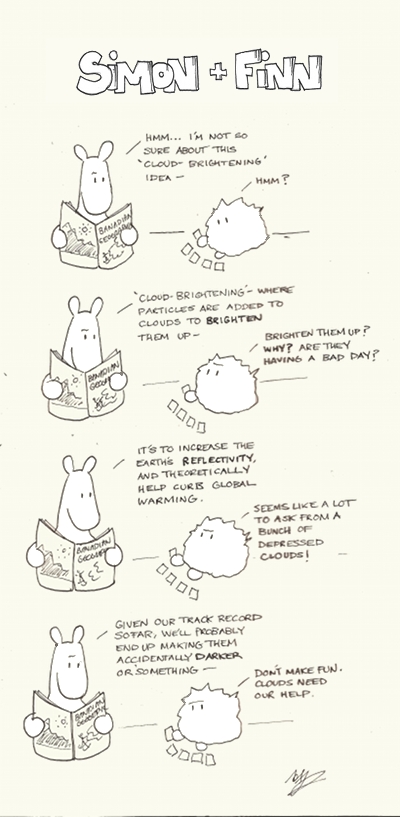
S&F: Bright clouds


S&F - Bright Clouds smallTrue story!  See the recent issue of Canadian Geographic, http://www.canadiangeographic.ca/magazine/jf13/geo-engineering_climate_change.asp