S&F Taming Tigers

S&F Tiger Taming smallThis cartoon wasn’t meant to be particularly funny per se, but is more a comment on a conversation (aka minor skirmish) I had earlier this week.  We were talking about risk-taking vs. non-risk taking behaviour, at which point my colleague quipped: “It’s easier to tame a tiger than to paint stripes on a kitty cat.”

The conversation went on for a while until I burst in with a series of complaints of how actually it would not be easier to tame a tiger, it would be in fact much easier to paint stripes on a cat (and safer).

They both looked at me with some amusement as I had missed the whole point, that being it’s easier to make behavioural changes (taming a tiger), than it is to make fundamental shifts in being (changing a kitty cat into a tiger).

All this said, my logic brain would still would favour painting stripes than taming a tiger, but the following quote sort of sums it up:

“As a single footstep will not make a path on the earth, so a single thought will not make a pathway in the mind. To make a deep physical path, we walk again and again. To make a deep mental path, we must think over and over the kind of thoughts we wish to dominate our lives.” 

— Henry David Thoreau
Hokusai and the Rokurokubi

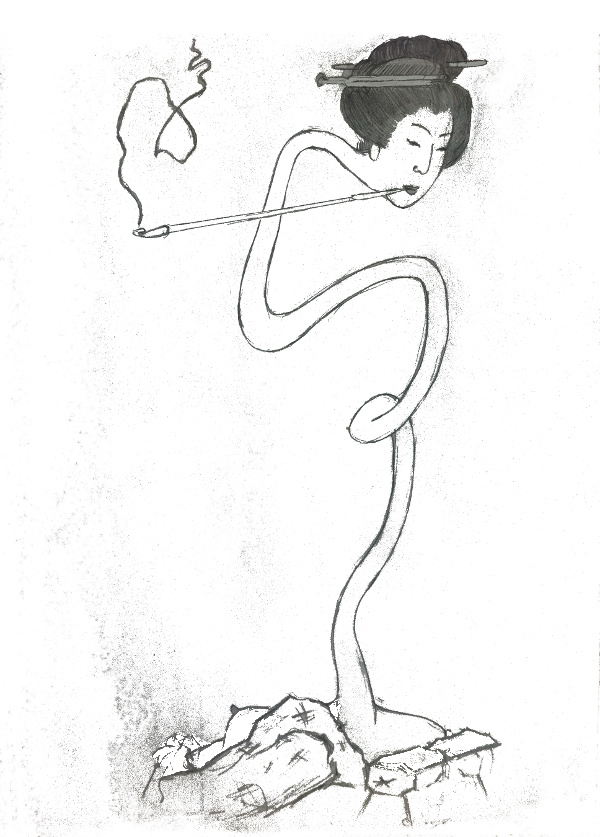
Last week I posted about the Japanese master artist Hokusai.  I thought I’d post another sketch of his work as I found the original quite eye-catching.  At first I thought it was an interpretation of opium dreams, but apparently it is actually a kind of Japanese spirit called Rokurokubi.

hokusai 2 smallThere are some bizarre tales of what these creatures get up to, including that of the soul detaching from the body during sleep and various sorts of tomfoolery.

It’s also cool to see how he echoed the curve of her neck with the smoke from the pipe.  I didn’t see any reference to pipe-smoking rokurokubi, so I’m a bit suspicious of the inclusion of that in his drawing although apparently there wouldn’t have been much opium in Japan during his time.

Hokusai’s Carp, adapted

I recently came across an interesting book, The Hokasai Manga.  Given Hokusai was born in 1760, he was certainly ahead of his time when it comes to a current definition of manga, although at that time it simply meant “sketches”.  Sketches they certainly are, all 3,900 of them.

Here is a sketch of a carp I adapted from one of his works in the book (Gyoran Kannon).

Carp small Hokusai adaptationI’ve always loved his masterpiece The Great Wave off Kanagawa, and in particular his views on mastery, as espoused by the following words:

“At the age of five years I had the habit of sketching things. At the age of fifty I had produced a large number of pictures, but for all that, none of them had any merit until the age of seventy. At seventy-three finally I learned something about the true nature of things, birds, animals, insects, fish, the grasses and the trees. So at the age of eighty years I will have made some progress, at ninety I will have penetrated the deepest significance of things, at a hundred I will make real wonders and at a hundred and ten, every point, every line, will have a life of its own..”

Beautiful eh?  Talk about taking the long view.. makes a refreshing change to the 10,000 hour maketh an expert concept, which translates to about five full-time years.  That would make one but an infant in Hokusai’s book!

P.S. For more musing on these subjects, see an earlier two-part post – Flow, Meaning & A State of Grace.

S&F and Philosophy Now: Why Philosophy?

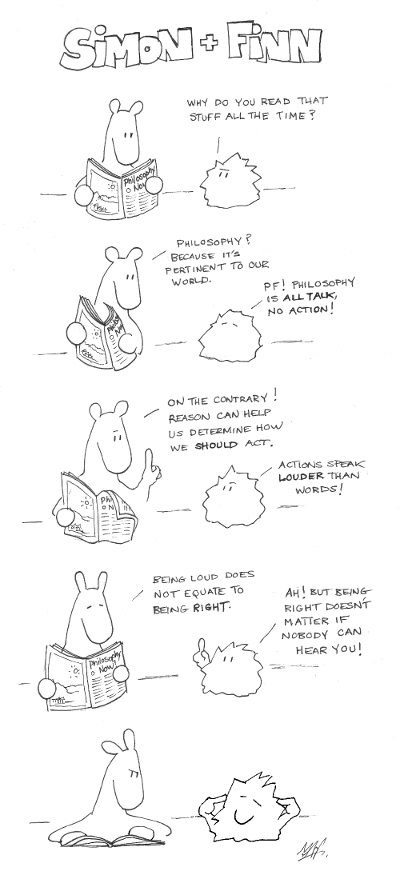
The following cartoon accompanied the print version of Philosophy in the Popular Imagination, a piece about modern perceptions regarding the value of philosophy, i.e. critical to self examination or time well wasted?

The article was written by Andrew Taggart, and repurposed by Finn. 🙂

S&F Philosophy vs Action FIN 1000 x 2100 V2 small

The Fate of Camus

I was flipping through a back issue of Philosophy Now the other day, when I was struck by a small piece penned by Ray Cavanaugh.  The piece was about the life of Albert Camus.  Look what a handsome chap he was –

albert-camusNow, I don’t know much about Camus, but have read The Stranger and remember coming away from that with a disquieting sense of having learned something about the world I didn’t really want to know.  The thing is, Camus seemed to specialize in the utter randomness of things; that abyss of meaninglessness that can cause one to stare morosely into one’s drink and question what the point of anything is.

What struck me about the article wasn’t its tone or tenor, but the simple description of how Camus died.  On January 4, 1960, the car he was in left the road at high speed, killing him instantly at the age of 44.  In his pocket was found the train ticket he hadn’t used after accepting the lift to Paris.  How random this decision, and what a tragic outcome.  One can only hope he would lift a glass in appreciation of this final absurdity.

On the bright side, he left us with one of the loveliest quotes ever penned:  “In the depths of winter, I finally learned that within me there lay an invincible summer.”

S&F Why create art anyway?!

S&FWhyArtCROPPEDsmalldarkerP.S. This week’s cartoon was inspired by a visit to the art treasures at the Royal Ontario Museum.  A simultaneously inspiring and humbling experience. 🙂

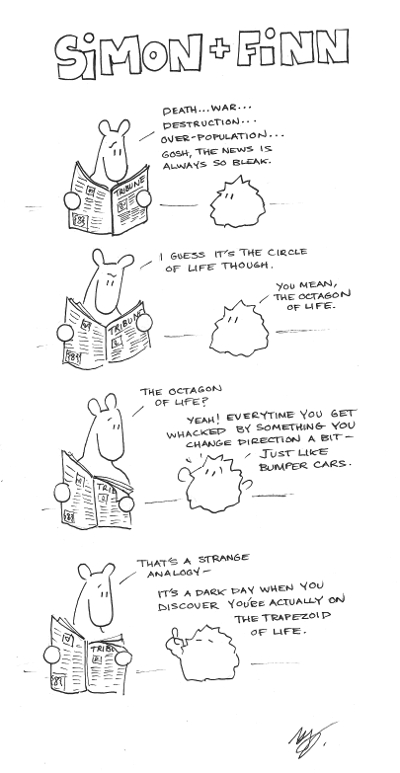
S&F The Octagon of Life

Image

S&FOctagonOfLifeSMALL2

S&F and Philosophy Now – “Moral Law”

The following cartoon accompanied the print version of Moral Laws of the Jungle, published in the 100th edition of Philosophy Now!  The piece, written by Iain King, discusses the role of empathy in human ethics.

Those of you who know Finn well might guess where this will go.  🙂

Phil Now Empathy cropped1

Teetering bulb of dread and dream

Russell Edson’s poem, The Floor, has been rattling around in my head for a few days – in particular, its brilliant last line describing the brain as “this teetering bulb of dread and dream..”  To me, Edson’s words perfectly capture the continuous mental oscillation between fear and Pandora’s box of eternal hope.

Somehow, this got conflated with an art assignment meant to depict the ambiguous, the ephemeral, and the visceral and I came up with this arguably creepy sketch (I should really have used CFL bulbs, but wouldn’t have had quite the same effect 🙂

BulbofDreadandDream2When drawing, I was also thinking about the tall and god-like figures in Scorched Earth by Lawrence Paul Yuxweluptun and Dali’s The Temptation of St. Anthony.  Russell Edson’s poem is reproduced below, and some mind-expanding reading on this area can be seen here.

The Floor

The floor is something we must fight against.
Whilst seemingly mere platform for the human
stance, it is that place that men fall to.
I am not dizzy. I stand as a tower, a lighthouse;
the pale ray of my sentiency flowing from my face.

But should I go dizzy I crash down into the floor;
my face into the floor, my attention bleeding into
the cracks of the floor.

Dear horizontal place, I do not wish to be a rug.
Do not pull at the difficult head, this teetering
bulb of dread and dream . .

— Russell Edson

S&F and Philosophy Now – “Thoughts on Oughts”

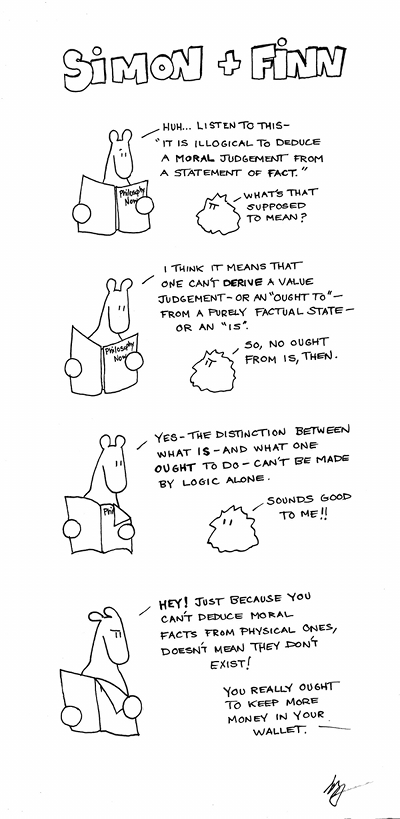
Happy 2014!  The following cartoon accompanied the print version of Thoughts On Oughts, a piece reflecting on Hume’s argument that we can’t derive a moral argument from facts alone (Philosophy Now, Dec/2013).  Finn, of course, sees the immediate opportunity here.

S&FOught clean blog