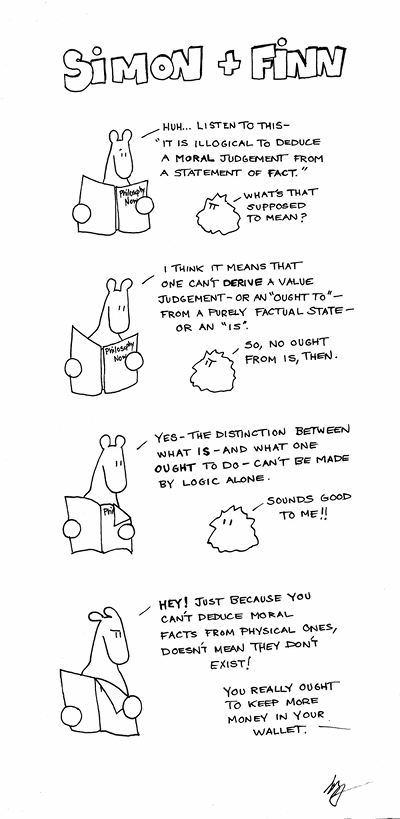
Happy 2014! The following cartoon accompanied the print version of Thoughts On Oughts, a piece reflecting on Hume’s argument that we can’t derive a moral argument from facts alone (Philosophy Now, Dec/2013). Finn, of course, sees the immediate opportunity here.
Category Archives: Philosophy
S&F and Philosophy Now – “Camus & the Myth of Sisyphus”
This piece was published in the Camus issue of Philosophy Now.
Bonus for S&F followers! The Easter Egg in the strip (where easter egg refers to the gamer term for a hidden message or joke) is that the song they are singing at the end is the refrain for.. click here to find out! 🙂
S&F in Philosophy Now – “The Self”
This cartoon was published in the August issue of Philosophy Now. This issue focused on how we define the idea of ‘self’, which was an interesting question to think about.
So, how would you define self? 🙂
S&F Zombiefied
Here’s a piece published in Philosophy Now’s very cool zombie issue. The article was about how zombies could technically have meaningful existence as they have both purpose (‘get brains’) and satisfaction (‘eat brains’). I’m simplifying it a bit, but was fun to read. 🙂
Update: I just found out the text for the article is available on-line for those who are curious, but the cartoon above is for subscribers/print version – you saw it here first!
S&F in Philosophy Now
Philosophy Now Reject Pile – No. 2
As promised, here is the last cartoon that was submitted to Philosophy Now! for Issue 94 (you can see the accepted cartoon here).
I think Simon got a little too nerdy in this one, however I love the idea of meta-mimosas… 🙂
Next week we’ll be back to Simon & Finn’s regular, coffee-fueled antics.
Thanks for reading!
Philosophy Now Reject Pile – No. 1
Last week, Simon & Finn were published in the UK journal Philosophy Now! That issue dealt with the idea of philosophy and literature. As well as I could understand it, there are some that believe philosophy is best expressed in a clear and almost mathematical manner, and others who feel a more literary or even poetic approach has just as much to offer.
I thought I’d show you guys some of the other cartoons that were submitted for the issue. This one was actually my favourite but the editor thought it might be too obscure. I think he was right, hence why he’s the editor of course! 🙂
Anyway, I’ll have one more reject to show you next week, and then we’ll resume normal programming.
Thanks for reading!!
Simon & Finn visit Philosophy Now!
This week’s Simon & Finn brought to you courtesy of Philosophy Now!
The latest issue looks at the intersection of philosophy and literature. The next issue will explore communicating philosophy, so if you have ideas for cartoons, I’m taking suggestions!
Next week: The Philosophy Now Reject Pile!
Plato’s Beard and the Pegasus-Idea
“On What There Is“, a brain-twisting piece by philosopher Willard Quine (1948), opines that when we say something doesn’t exist – for example Pegasus – this is not necessarily true. This is because Pegasus must exist in some manner for us to even be able to take sides on its existential dilemma, poor thing. That is, the material, breathing, hoof & wing Pegasus is not akin to the idea-Pegasus in our minds – and it this latter which offers us a common ground, an agreed semantic framework for discourse whose existence cannot be denied (that’s right, Pegasus will not be denied! Neigh!).
Quine happily explores the particulars of this ontological – or perhaps more appropriately semantic – puzzle by assuming various approaches to correctly expressing Pegasus’s material quandary. For example, instead of saying Pegasus doesn’t exist, we could instead say: “Pegasus does not have the specialized attribute of actuality”. Or, more succinctly, “Pegasus is an unactualized possible”. And by so doing, we multiply the number of potential Pegasi available to us all in the name of philosophical precision. This “slum of the possibles” as Quine so puts it, is quite the breeding ground for disorderly elements, as it means a litany of existence-caveats would litter every avenue of discourse.
Going even further along his merry way, Quine indicates yet another approach may involve treating the noun Pegasus as a derivative, and instead have this be identified as “the thing that is-Pegasus” or even “the thing that pegasizes”. Even Pegasus had to snort somewhat at the latter with its french conjugation overtones, as it’s a matter of time before nous pegasons is understood to mean collective flights of philosophical fancy.
P.S. This ontological ride has some origins in the Sophist, where Plato introduces the idea that what “is not” – in some sense – still “is”. To wit, Quine nicknames this ontological puzzle Plato’s Beard, seeing as it’s been dulling Occam’s razor for centuries.
Ernie & The Nietzsche Monster
There once was a rotund chap named Ernie.
Ernie was a happy sort. He liked to wander through his domain…
Laughing and chatting with his friends along the way..
Yep, Ernie was a happy chap.
One day though, Ernie noticed something strange..
Ernie did not know it, but he had stumbled across a monster!
Now Ernie – in addition to being a happy chap – was also a bit naive..
So Ernie decided to be friends, and associate himself with the monster.
Ernie took the monster under his wing (or paw), frequenting all his favourite haunts..

Over time though, Ernie started to notice something peculiar..
Ernie wasn’t sure.. but it seemed like his friends were disappearing!
Little did Ernie know that – when he wasn’t looking – the monster had cut a swathe of destruction through his kingdom!
Ernie started to grow suspicious of the monster…
With that the monster started crying, which made Ernie feel bad.
And this is when Ernie made a big mistake.
With that pronouncement, Ernie thought of a plan. He would somehow help make the monster become less – well – less ‘monster-ish’.
He took the monster jogging….
…to the library…
…and even out for sushi…
But monster remained a monster.

Over time, Ernie’s spirit grew tired of battling the monster’s nature…
…became despondent…
… and eventually, weak.
Several years passed, and Ernie forgot who he was – and the difference between him and the monster.
Ernie had thought he could change the monster, but the monster – true to its nature – had changed him.
After a long time of monster-like living, Ernie had a strange dream.
He dreamt he was walking through his domain…
When all of a sudden he fell into an abyss!
The abyss seemed to go on forever..
His fall abruptly ended when Ernie emerged from a huge hole..
…which turned out to be the eye of a gigantic being!
Ernie stared, transfixed, at the apparition.
All at once, it spoke!

And with that, Ernie woke in a fright!
Ernie thought carefully. He thought back to his kingdom…the appearance of the monster.. the disappearance of his friends… and the gradual darkening of his life…
And Ernie then realized:
And with that realization, his monster-shell fell away and Ernie regained his true spirit.
With his renewal, Ernie decided to deal with the monster for once and all.

And the monster left.
Slowly, peace and joy returned to the kingdom.
Things were almost as before.
But sometimes, a cloud would pass over the sun and Ernie would remember his strange dream….
Years later, when Ernie would notice someone befriending a monster, he would shake his head and enigmatically pronounce:

“He who fights with monsters might take care lest he thereby become a monster. And if you gaze for long into an abyss, the abyss gazes also into you.” – Friedrich Nietzsche